
When Matter Becomes Prayer
Updated: Sep 7
Teilhard de Chardin's Cosmic Liturgy

I had a powerful experience while sitting on the wooden floor of my apartment on a Saturday morning, scribbling away in my prayer journal. As the pages curled with ink under my hand, I had a sudden realization.
If God created every molecule in the universe, then that included the coupled oxygen atoms that surrounded me, not only in the room where I sat, but in every place I’d ever been, and every place I’d ever go.
And if every molecule of oxygen bears a trace of God, I thought, then I was being held, embraced by an invisible force of love, at all times.
Twenty years later, I still remember this moment as one of the most profound experiences of my spiritual life.
I didn’t know then that I had stumbled my way into what French scientist and mystic Pierre Teilhard de Chardin called the divine milieu, the fact that all creation bears the divine and is held together by the divine.
“At the heart of matter,” he wrote, “is the heart of God.”
There was a time, though, when Teilhard de Chardin feared that he loved the world a little too much. Raised in a French Catholicism that saw physical matter as oppositional to the more pure and exalted spiritual realm, he tried to hold to this narrow viewpoint when he became a Jesuit priest.
But he found that he couldn’t do it.
From the time he was a boy in the volcanic hills of central France, Teilhard had been captivated by the solid, enduring presence of the earth. He once carried an old iron key in his pocket as if it were a holy relic, a symbol of permanence. Rocks, metals, fossils, and the sweep of the countryside spoke to him of a hidden Presence pulsing through all things.
Later, as a young priest and scientist, he felt torn between church teachings that distrusted “the world” and his own instinctive love for creation. Yet the more he studied life and matter, the more he sensed God’s voice echoing back from every creature and atom: “Ego sum, noli timere” (“It is I, do not be afraid”).
Years later, on a scientific expedition through the steppes of China, Teilhard found himself without bread and wine to celebrate the Eucharist—something he did daily as a Jesuit priest. So there, standing alone in the rising sun, he used the elements God had given him. The earth itself became his altar; the earth’s land, labor, loss, and longings, his bread and wine.
This improvised liturgy—later named his Mass on the World—became a living sign of Teilhard’s vision: that the whole of creation, like the Eucharist itself, is charged with God’s presence.
In our twenty-first-spirituality, none of this sounds terribly radical. And yet, the conclusions Teilhard de Chardin drew from his revelations landed him in hot water with both the Jesuits and the Vatican; he was censured and exiled repeatedly.
What on earth was so objectionable in his theology?
It was Teilhard de Chardin’s complete embrace of science, including evolution, as part of the revelation of God. He saw the entire lifespan of creation as a process of physical and spiritual evolution–one in which all humans are invited to participate alongside God. This process had a fixed end point: complete unity between the created world and the fully realized Christ.
And because he saw all of humanity as co-creators of this state of oneness with God, he had no use for the doctrine of original sin. Every human doing good work was part of this cosmic process–no profession of faith required. Our time on earth, Telihard de Chardin believed, is not an audition for heaven, but an opportunity to join the good work God is doing and push all of creation toward its fullest realization.
Just as animals and plants evolve over time, so must human consciousness, he taught. We are all called to this work of inner evolution or “involution. Teilhard called this hopeful, forward-driving movement the Christ Project—the idea that all of creation is evolving toward its fulfillment in Christ.
If the world offered only two opposed paths, science and faith, this Jesuit forged his own third path, in which both science and faith were intertwined. “Let us take care not to reject the least ray of light from any side,” he said, referring to scientific discoveries. “Faith has need of all the truth.”
You can see why a Church already wary of evolutionary science bristled at Teilhard de Chardin’s theology. He claimed that creation itself was a living text of divine revelation, just as sacred as Scripture and tradition.
But time has softened that resistance. In the decades since his death, his writings have spread, and his vision feels more urgent than ever—a call to a collective love that is both tender and generative, and to explore the physical world as a pathway to God.
Teilhard de Chardin called us to love “the not yet” and to trust that it would be.
The evidence for this hope, he found, was all around us. In every blade of grass. In every drop of water. And, yes, in every molecule of oxygen we breathe.
“All we have to do is let the very heart of the earth beat within us,” Teilhard de Chardin said.
One Saturday morning twenty years ago, I got my first inkling of the divine milieu. But Teilhard de Chardin’s wisdom assures me I’ll be growing in awareness of it, slowly but steadily inching closer to it, for the rest of my life.
Inspired by his vision of the cosmic unfolding of the Body of Christ, Teilhard de Chardin called himself a pilgrim of the future. And he invited us all along his path.
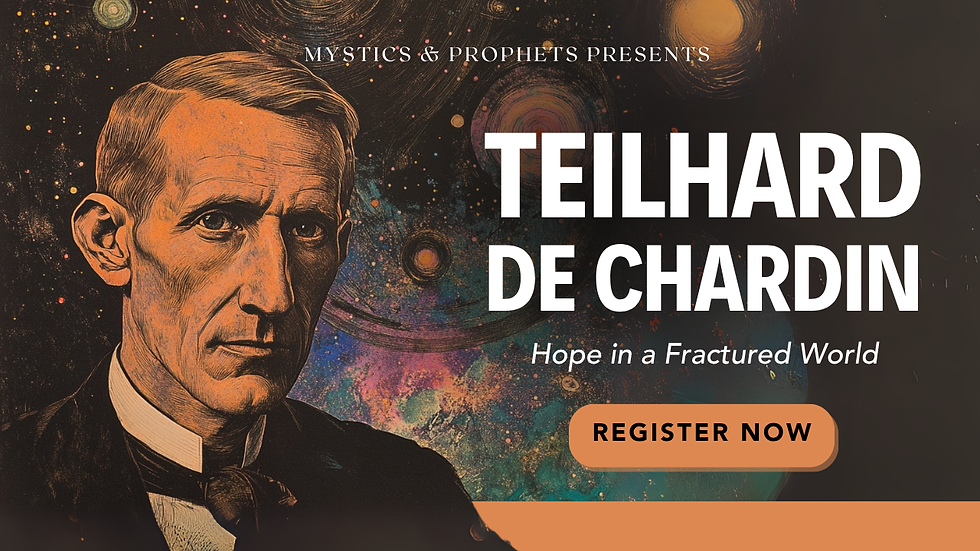
In these frightening times, are you longing for a dose of Teilhard de Chardin’s persistent hope for the future of humanity? Please join us for a one-time Masterclass on how we can live his spirituality, adopt his prophetic vision, and be carried by the divine milieu into a future bright with hope and unity.

Cameron Bellm is a Seattle-based spiritual writer, speaker, and retreat guide. After completing her PhD in Russian literature, she traded the academic life for the contemplative life, combining her love for language with a deeply-rooted spirituality. Her work can be found at the intersection of mysticism and activism, linking ancient spiritual practice with modern social engagement. Cameron's work has been featured in America Magazine, National Catholic Reporter, Jesuit Media Lab, and more. Her first book, The Sacrament of Paying Attention: How Writers, Artists, and Mystics can Lead Us into Sacred Human Communion, will be published in 2026. When her nose isn't in a book and her feet aren't softly padding through a library, you can find her marveling at the ferns, salmonberries, and spruce trees along a Seattle trail.


Comments